
A model that works below the code
Most AI coding tools help people write software. Maxwell is aimed at what happens after the software exists. Processors do not run source code; they run a binary, a machine-generated translation of it. Maxwell works at that level, studying how a program interacts with its data and its chips, then changing the machine instructions so the same job takes less hardware.
Two parts of that pitch matter more than the category name. The first is that the changes can be applied while a program is running in production, so a customer does not have to adopt a new codebase to get the gain. The second is verification. Shashua told the Wall Street Journal that the hard problem was proving a faster version still behaves like the original, and that doubleAI's step forward was doing that proof formally and mathematically. That proof is the company's account of its own guarantee: the launch materials do not establish the verification method's scope, assumptions or coverage, and readers should not fill that gap in. If the guarantee holds as broadly as the company describes, it answers the obvious objection to letting a model rewrite the software you already ship — in production, while it runs.
The one result you can check
The launch came with a list of numbers, and they are not all the same kind of number. Start with the one that is documented end to end.
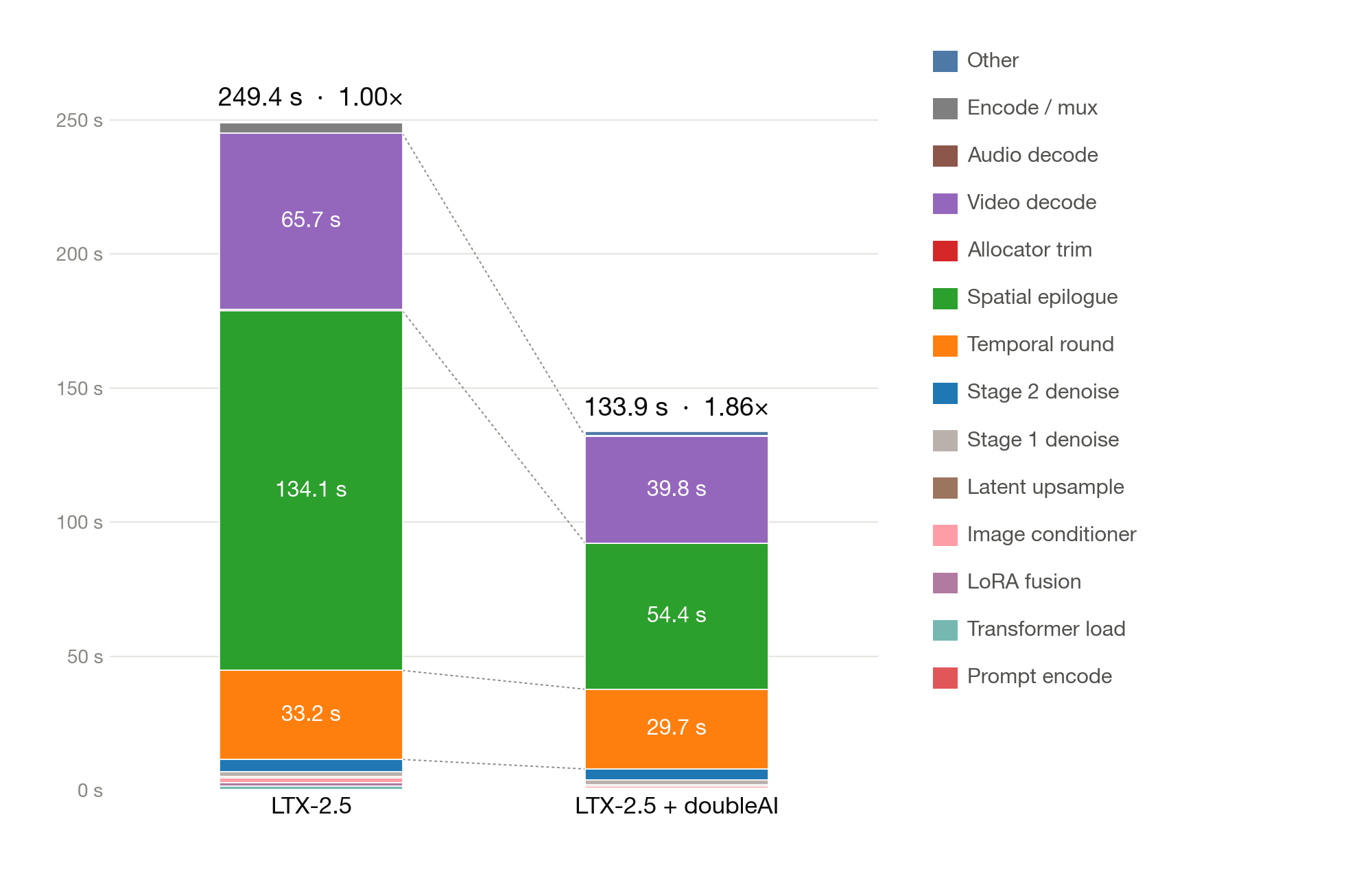
Working with LTX, doubleAI pointed Maxwell at LTX-2.5, an open video model whose inference pipeline was already heavily optimised by its own team. On two Nvidia B200s, the same five-second 4K clip took 250 seconds before Maxwell's changes and 134 seconds after — about 1.87x the speed, roughly 46% less elapsed time, described by the company as nearly twice as fast. It is still 134 seconds to generate five seconds of video, and it is one documented workload, not a general multiplier for video generation. The post does not stop at the headline. It reports a quality check — 41 dB PSNR against the original on the benchmark prompt, a pixel-level measure the company describes as visually indistinguishable for this comparison, not a guarantee for every clip — and, separately, the company reports the soundtrack preserved bit for bit. It names the individual changes, and every one of them is in LTX's source code for anyone to read: the optimisation changes are open source, which is not the same as Maxwell itself being open source.
The changes themselves are unglamorous, which is part of why they are credible. In the original pipeline the two GPUs exchanged 262 MB of video data per GPU in every transformer block at every step so the audio could attend to the whole picture. Maxwell swapped that for partial answers of about 1 MB, merged exactly. The 4K finishing pass was denoising most pixels almost twice because its tile overlaps were larger than the seams required. Thinner overlaps, and one row of tiles fewer, brought that close to once per pixel. None of this is a new model architecture. It is the kind of waste that accumulates in fast-moving code, found systematically.
The rest of the list
Set against that, the other launch figures arrive with no comparable trail. A 67% cut in one early customer's compute costs is a Wall Street Journal report of a company claim about a customer it does not name. The cuGraph result is a proportion — 55% of the library's algorithms sped up by two times or more, not a 55% overall improvement — and the 38x figure is for pandas on the PDS-H query benchmark workload, not for pandas generally. Both are doubleAI's own figures from its own demonstrations. CTech, covering the launch in the company's home market, states the position plainly: the figures have not been independently verified, and the announcement does not provide enough about the tests, hardware or baselines to judge how broadly they replicate.
That does not make them false. It makes them a different category of evidence from the LTX work, with too little published test detail to assess how far they generalise, and readers should price them differently. The launch materials document the LTX result more fully than the other headline figures.
Saving compute, at scale, costs compute
There is a tension in the funding plan, and it is instructive rather than damning. The Wall Street Journal reports that about half the $200 million round is allocated to buying 1,000 Nvidia B300 Blackwell GPUs — a reported plan, not a completed purchase. A company selling relief from the compute shortage is itself queueing for scarce hardware, because training and running a model that can do this work is compute-hungry, and because it wants to compete with the research output of far larger labs. That allocation shows the capital demands of building a compute-optimisation business; it is not evidence that Maxwell is inefficient or that its model contradicts itself. The commercial question is whether the savings customers can reproduce exceed the cost of delivering Maxwell across real workloads.
The market it is selling into is real enough. SemiAnalysis data cited by the Wall Street Journal put the cost per hour of renting Nvidia H100 compute on a one-year contract 60% higher than a year earlier — a one-year-contract figure, not a price rise across all GPUs, providers or contracts — and doubleAI's planned pricing model, charging on the savings delivered, only works if customers' bills are large and painful. Whether Maxwell's documented gains transfer from a partner's showcase pipeline to the messy software inside a paying enterprise is the open question. The LTX post is a reason to take the question seriously. It is not yet the answer.
Sources
- [1] doubleAI, "Maxwell Makes LTX-2.5 Generate 4K Video Nearly 2x Faster" (company research post, 19 October 2026; 250s to 134s on two B200s, PSNR 41 dB, changes open source)Read source
- [2] CTech (Calcalist), "Shashua's doubleAI unveils AI models that optimize how software runs" (19 October 2026; $200M round, investor list, ~40 employees, valuation above $1B, charge-on-savings model, early access, explicit not-independently-verified caveat)Read source
- [3] SiliconANGLE, "Nvidia, Dell back $200M round for AI model developer doubleAI" (19 October 2026, updated 20 October 00:21 UTC; round co-leads, cuGraph/pandas/LTX summaries, WSJ B300 report)Read source
- [4] PYMNTS, "Nvidia-Backed doubleAI Debuts AI 'Code Execution' Models" (19 October 2026; WSJ reporting on CEM category, formal verification, Shashua quote, SemiAnalysis H100 +60% figure)Read source
- [5] RuntimeWire, "doubleAI launches Maxwell, citing a 67% cut in one customer's compute costs" (19 October 2026; WSJ as primary source, 67% figure flagged as company-reported)Read source
- [6] doubleAI official site (Maxwell described as a code execution model for performance engineering; rewrites and verifies low-level code)Read source