
A different way to write, at a larger size
Most language models write the way a person types: one token, then the next, each conditioned on everything before it. Diffusion language models draft a block of text with the positions masked, then fill in the positions the model is most confident about, in parallel, and repeat. The attraction is speed. The open question, which ALFW noted when Inception released its closed Mercury 3 on October 19, is whether that approach keeps working as models get bigger.
Clover is the open-weight attempt at an answer. DiffuSpace comes out of the University of Hong Kong's NLP group, whose Dream 7B model in April 2025 was an early proof that a diffusion model could compete with autoregressive models at small scale. The team says the Dream family has since passed 2.7 million downloads on Hugging Face.
Clover keeps the skeleton of Qwen3.6-35B-A3B and changes how it generates. The changes are specific: a bidirectional version of the Gated DeltaNet memory, so tokens inside a block can attend to each other while the already-written prefix stays causal; a learnable calibration for block size; and a separate, zero-initialised convolution branch for right-side context. In the Hugging Face implementation, a block starts as 32 masked tokens, any position scoring above a 0.95 confidence threshold is filled, and if none qualifies, the single most confident position is filled so the block still advances.
Six agent benchmarks, one author
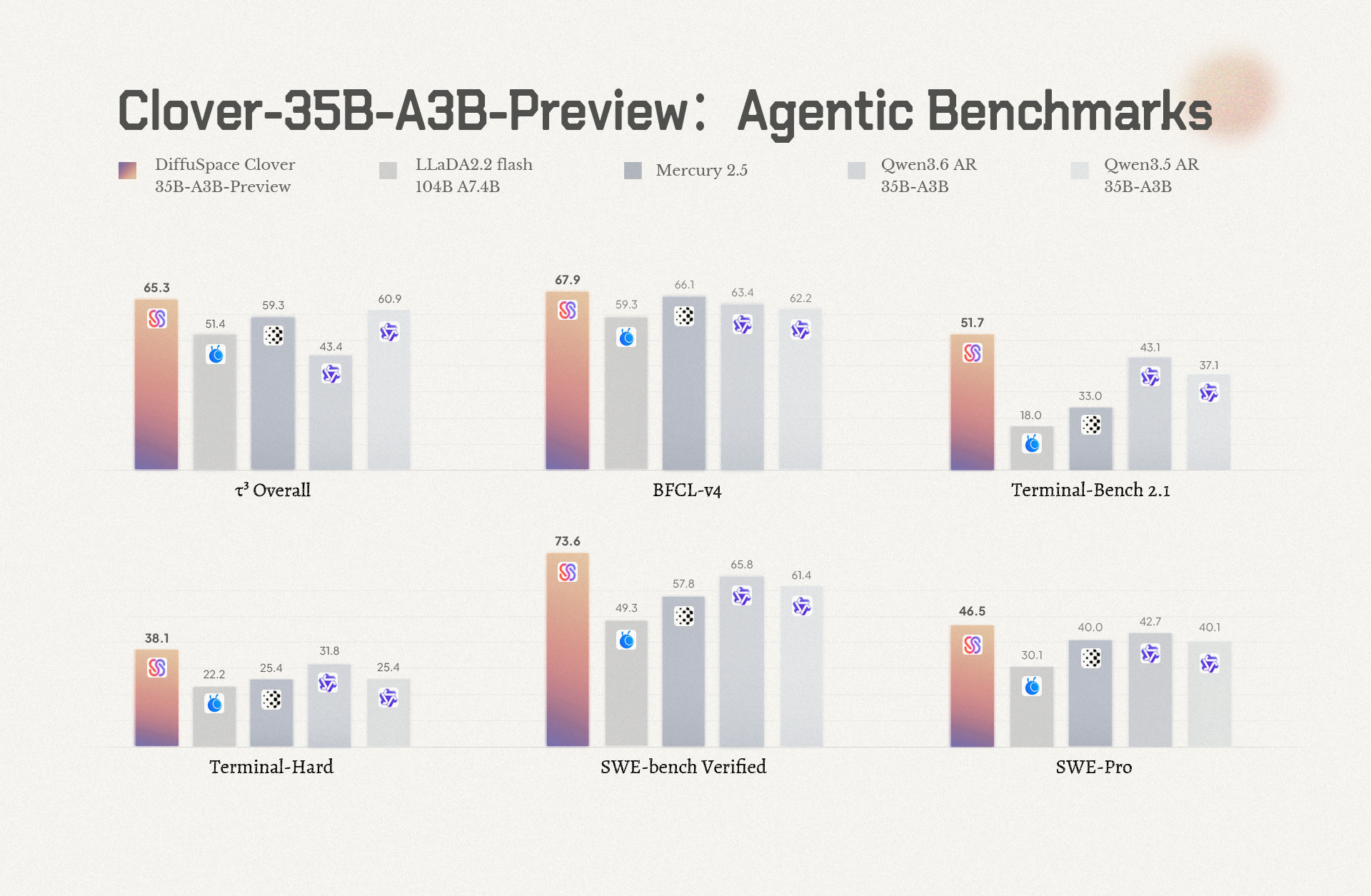
The headline claim is narrow, and it should be quoted narrowly. Across the six agent benchmarks in DiffuSpace's own comparison, Clover scored highest among the models listed. The named rivals are LLaDA2.2 Flash, Mercury 2.5, and the two autoregressive Qwen models at the same scale, including the Qwen3.6 model Clover itself derives from. The scores: 73.6 on SWE-bench Verified, 51.7 on Terminal-Bench 2.1, 65.3 overall on tau-cubed, 67.9 on BFCL-v4. In a second comparison against smaller, efficiency-focused models, it led on six of nine benchmarks, and its margin over MiniCPM-V 4.7, another 35B-A3B model, was 28.0 points on SWE-bench Verified.
Two qualifications belong next to those numbers wherever they travel. First, they are DiffuSpace's own results, from its launch post and model card. No independent reproduction had appeared by the time of writing. A reported 73.6 on SWE-bench Verified would be a striking result for a model with about 3 billion active parameters. But the score is meaningful as a comparison only to the extent that the evaluation harness, tool access, sampling and scoring conditions are comparable. Independent reproduction is still needed before treating it as an established lead.
Second, the diffusion rival in the chart is out of date. Mercury 2.5 is listed; Mercury 3, released nine days before Clover, is not. Mercury 3, released on October 19 according to ALFW's earlier coverage, is absent from the chart. DiffuSpace's comparison therefore does not establish how Clover performs against the latest diffusion model, even though Mercury 3 is closed and API-only. The table supports only the narrower claim that Clover leads the models DiffuSpace chose to include.
Speed, measured on the maker's workload
The speed figures need the same handling. DiffuSpace reports 680 tokens per second on a single GB300 at BF16 with a batch size of one, measured on its internal agent workloads, and 515 tokens per second on a single H200 on agent tasks, against 365 for a same-scale Qwen model sped up with DFlash2. Internal agent workloads are a legitimate thing to measure, and faster generation can reduce latency when an agent must complete multiple sequential steps. But tokens per second is not end-to-end task speed: tool calls, orchestration, context length and the number of steps also matter. These figures should be read as performance on DiffuSpace's stated workloads, not as a general measure of agent productivity.
There is a second, quieter caveat in the model card. DiffuSpace recommends its own SGLang implementation for serving and for evaluation, and warns that the standalone PyTorch path on Hugging Face can produce different text under the same settings because of small numerical differences between the two implementations' operations. Anyone setting out to reproduce the benchmark scores should start from that warning: the path you run is part of the result.
Practicalities, for anyone who wants to try. The BF16 weights need about 69 GB of memory, plus room for inference state, so the published form is a datacentre-card model. The consumer-card version is a reported INT4 deployment on an RTX 5070 Ti with 16GB of VRAM, reaching 101.8 tokens per second on MATH-500, against 48.5 in the team's comparison tests with similarly sized MiniCPM and Qwen models. That is one maths benchmark, not a general verdict on how the quantized model feels in use. The model card also notes, plainly, that very long generations can turn repetitive, which is why repetition and length-bias controls ship with defaults already set.
The decision model that has not shipped
The launch post spends its last section on a second model: a decision model built on Clover, which answers related questions together, in one denoising pass, up to eight at a time, instead of one call per question. In an internal validation set of 500 groups covering 2,420 related questions, DiffuSpace reports that answering jointly scored 95.0% per question and got every answer in a group right 80.4% of the time, against 89.8% and 62.4% for the same model answering each question separately.
Read the comparison against TypeSafe's Jev — readers of ALFW's earlier coverage may recall it — with more care. DiffuSpace's launch post lists Jev at 63.6% and 15.8% on the corresponding measures, describing the figures as historical evaluations. The post does not establish that the models were tested under a common, freshly run evaluation harness, so the numbers should not be treated as a direct head-to-head result. The joint-answering idea is genuinely interesting, because related judgments that contradict each other are a real failure mode in structured decision work. It is also, for now, a promise: the decision model, the post says, will be released at a later date. What shipped this week is Clover itself.
The weights are downloadable under the published Apache-2.0 license, which does not impose a revenue-based restriction. Users should still review the repository's license files and any applicable notices for the exact distribution they download. The release comes from a team with a public track record in this exact architecture. The scores that would make it a landmark are its maker's. Both things are true: the weights are available, and the headline results can in principle be tested independently. Reproducing them will still require compatible hardware, the right evaluation setup and enough compute to run the relevant agent benchmarks. The release makes verification possible; it does not make verification trivial.
Sources
- [1] DiffuSpace, "Clover-35B-A3B-Preview" launch post (October 28, 2026)Read source
- [2] DiffuSpace, Clover-35B-A3B-Preview model card, Hugging FaceRead source
- [3] DiffuSpace, Clover-35B-A3B-Preview code and inference backends, GitHubRead source
- [4] ALFW, "Mercury 3 Claims 1,068 Tokens a Second. Its Quality Lead Is Less Clear." (October 19, 2026), for the Mercury 3 release date and its closed, API-only accessRead source