
Three agents, one narrow permission
The headline version of this launch is that Claude can now approve its own work. The product is more carefully fenced than that.
Code Review, the part that already existed, reads a pull request against the codebase, verifies its own findings adversarially, and posts them. PR Steward does the janitorial work that keeps a pull request alive: it responds to failing CI checks, merge conflicts and review comments from Code Review, other tools or teammates, and after every push it comments with what it changed and how to undo it. Developers can steer it with @claude or stop it with @claude stop.
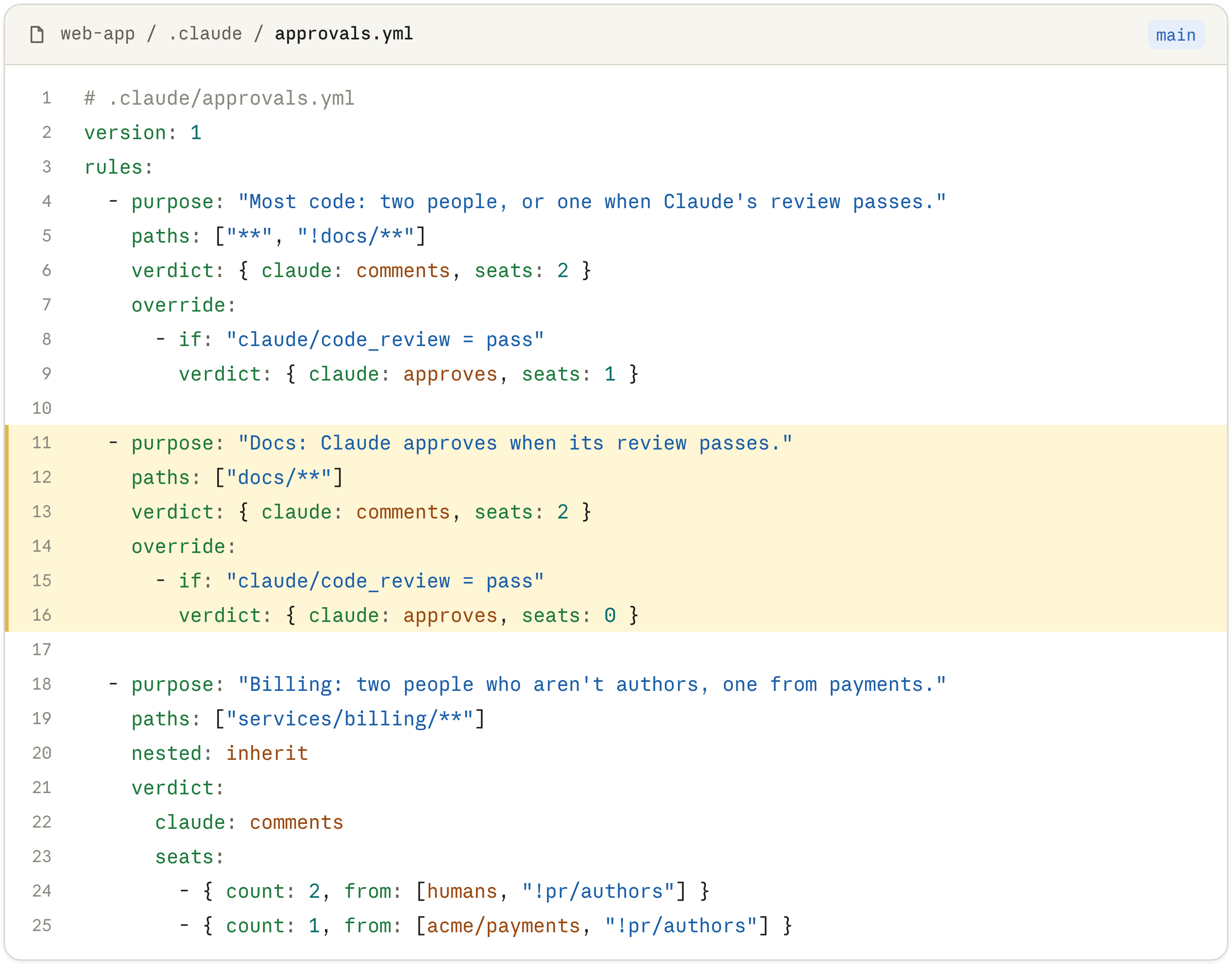
Steward is also the agent with the explicit limit. Anthropic says it "is designed not to approve or merge pull requests." The one component allowed to approve is Claude Approvals, and it does not judge code on its own terms. It applies an approval policy that the team writes as a file in the repository, closer to a programmable CODEOWNERS file than to a reviewer. It can weigh signals the team chooses, including Code Review findings or the team's own natural-language classifiers, and it can approve routine changes or route a change to a person, as the policy directs. Claude Approvals starts when a connected repository has a policy file on its default branch, and an admin can turn it off.
That split is the actual design decision in this launch. The agent that touches the code is designed not to sign it off. Whether that separation holds in practice depends on the policy file, which is the team's own work.
Observe mode is the recommended start, and it can still bill
Anthropic's own guidance sets the pace. For most customers, it recommends enabling Claude Approvals in observe-only mode first, to build confidence before branch protection requires its green light. The vendor selling automated approval expects a period of watching the approver not approve, first.
Watching can cost money, depending on the policy. Claude Ship usage is billed on tokens. Claude Approvals itself has no base charge, but the classifiers inside a policy are billed on the tokens they use, and a policy that uses Claude's review triggers a billed Code Review even in observe mode. Admins can set spend limits for Code Review and PR Steward; the post describes no equivalent built-in cap for classifier spend inside a policy. Teams budgeting a trial should price the observation period, not just the live one.
Two further limits decide who can run the trial at all. Claude Ship is restricted to Claude Team and Enterprise plans and to repositories on GitHub. And it is not available to organizations with Zero Data Retention, the HIPAA configuration, or customer-managed encryption keys.
The one performance number is Anthropic's own
The launch post offers a single outcome statistic: on the Claude Code team, where Claude's review is one layer of a broader process, merged pull requests more than doubled from June to September, and the share reverted fell by more than 40%.
Read it with its own qualifiers attached. It is the vendor's internal team, over one summer, with no baseline counts published, and Anthropic itself frames Code Review as one layer among several. The figures do not isolate what Claude Ship changed in that team's merge or revert rates.
The credit offer runs on a different clock. Eligible Enterprise organizations can claim at least $10,000 in Claude Ship credits, usable within 30 days of claiming, with a claim deadline of January 15, 2027. The observe-first advice carries no such deadline.
Sources
- [1] Anthropic, "Introducing Claude Ship", claude.com, November 23, 2026Read source
- [2] Reuters, "Anthropic launches Claude Ship to help developers ship code faster", November 23, 2026