
Read-only is a real limit. It is not the whole risk
The design decision in this launch is what Claude is not allowed to do. It cannot transfer money, pay a bill, cancel a subscription or place a trade. For a first release that touches bank credentials, even indirectly through Plaid, that restraint is the right call, and Anthropic states it in the first paragraph rather than the footnotes.
Read-only access still hands a model a detailed financial history: two years of transactions with amounts, dates, merchants and categories, across as many as 16 banks. The exposure in this product is not theft. It is a wrong total stated with confidence, and a record of your spending sitting inside a chat product. Anthropic's announcement is unusually direct about the first half of that: Claude can make mistakes, so ask which transactions sit behind a number and check important figures with your bank.
Anthropic's Help Center identifies three specific ways a total can mislead. Balances can be a day or two old. An account connected through two different logins can be counted twice if the bank presents it differently under each. And when Claude cannot read a linked bank, that bank's spending is left out of the figures, which can make the amount remaining before payday look larger than it is. None of these is a reason to avoid the tool. All three are reasons to treat its totals as a draft to verify, not a statement.
What Claude actually sees, account by account
For investment, loan and credit-card accounts, Claude reads balances and credit limits only. It does not read investment holdings, trades, interest rates or loan terms, even where Plaid's own consent screens ask permission to share broader financial data. Anthropic says Claude currently receives only the categories of information listed in its Help Center. So the feature can tell you what you owe and what you spent. It cannot yet analyze a portfolio, because it never sees one.
The wider place is account identification. Plaid normally passes only the last few digits of an account number, usually four. Anthropic's Help Center notes that if a bank writes a full account number into an account name or a transaction description, Claude may see it there. That is a small, concrete detail, and it is the kind that decides whether a privacy summary is honest.
Two more boundaries matter in daily use. The promise that chats are not used for training covers the Personal Finance hub; share the same figures in an ordinary chat and your normal privacy settings govern them instead. Unlinking a bank stops Claude from reading that bank's accounts, but it does not erase information already used in conversations. Existing chat responses remain in chat history until deleted, while published artifacts and shared links can continue to expose figures until they are separately removed. Deleting the original chat does not automatically delete a published artifact.
There is another distinction worth knowing: linked accounts are not restricted to the Personal Finance hub. Claude can also read them in ordinary chats without asking each time, unless the user turns Plaid off for chats. Those conversations follow the user's normal privacy settings, not the hub's no-training commitment. Connecting an account therefore creates a broader permission than simply opening the finance dashboard.
A crowded week for AI and money
ZDNet framed Anthropic's Personal Finance launch as an answer to ChatGPT Finances. The comparison is useful context, but the more important question is how much of a user's financial history each product requires them to share.
Anthropic says Personal Finance has no ads or sponsored recommendations, and that it does not offer its own credit cards, loans or savings accounts. Those are company-stated product characteristics, not an independent assessment of its commercial incentives.
What comes next, by Anthropic's own account, is the harder part. Personal Finance is described as a first step, and the company is inviting banks, wealth managers and financial services firms to help it work alongside licensed professionals on larger decisions. That is also where read-only stops being a complete answer. Moving from summarizing transactions to personalized investment recommendations or other regulated financial services would raise different legal and oversight questions, depending on the service and jurisdiction.
Sources
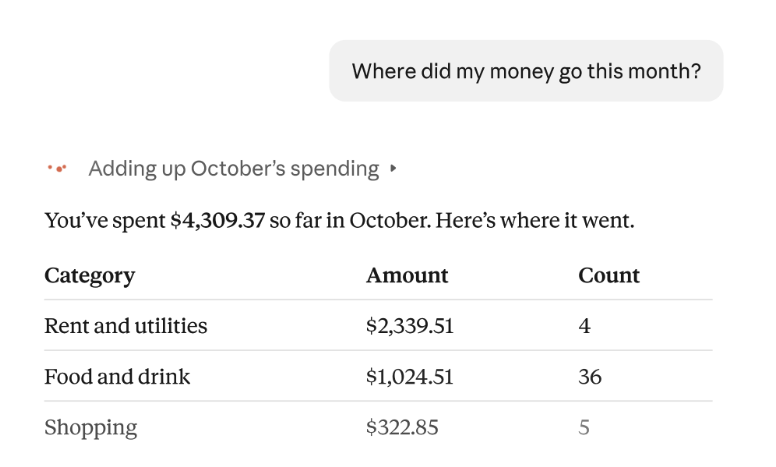
- [1] Anthropic (primary), "Introducing Personal Finance in Claude", claude.com, November 5, 2026 (read first-hand in full at Gate 1: read-only access; cannot move, manage or invest money; beta rolling out this week on Pro, Max and Ultra in the US; worked example of $4,309.37 monthly spending, more than half to rent and utilities, $1,024.51 on food and drink, four upcoming payments and $1,393.22 left before payday; duplicate charges, unexpected fees and rising bills; APR explanation with interest totaled; weekly spending charts, due-date calendars and adjustable dashboards; no ads or sponsored recommendations and no credit cards, loans or savings accounts of its own; Plaid sign-in so Claude does not ask for or see the bank password; data list of bank name, account name, type and last four digits, balances, credit limits and up to two years of transactions; hub chats not used to train models, outside-hub sharing under normal privacy settings; unlinking means Claude can no longer see the data; "Claude can make mistakes" warning; next step of working alongside licensed professionals and regulated firms, with an invitation to banks, wealth managers and financial services firms)Read source
- [2] Anthropic (primary), "Use Personal Finance in Claude", Claude Help Center, updated 2026-11-05T18:00:48Z (read first-hand in full at Gate 1: link up to 16 banks; Plaid gives only the last few digits of each account number, usually four, but a full number may appear in an account name or transaction description; investments, loans and cards limited to balances and credit limits, not holdings, trades, rates or terms, and Claude currently receives only the categories of information listed in the article; accuracy caveats that balances can be a day or two old, an account linked through two logins may be counted twice, and while Claude cannot read a bank that bank's spending is left out of the figures; Claude reads linked accounts in ordinary chats without asking each time, unless the user turns Plaid off for chats; unlinking stops Claude reading the bank, but what Claude already said stays in chats and in any artifacts or shared links until removed, and an artifact stays until deleted even if the chat is deleted; the feature does not appear outside the US or on a VPN connecting from another country; banks stay linked when a paid plan ends; account deletion unlinks automatically)Read source
- [3] Unite.AI, "Anthropic Introduces Read-Only Personal Finance Beta in Claude", November 5, 2026 (read in full by the desk: web, Desktop, iOS and Android surfaces; Free, Team and Enterprise excluded; dashboard widgets for spending, cash flow, accounts, subscriptions and upcoming bills; linked accounts unusable in scheduled tasks, Cowork and Claude Code, may not work in projects, unavailable in Claude Duet; exports do not yet include dashboards)Read source
- [4] TechCrunch, "Claude can now analyze your spending with its new Personal Finance tool", November 5, 2026 (independent corroboration of the beta, plans and read-only scope, via search results)Read source
- [5] ZDNet, "Claude's new Personal Finance tool aims to help analyze your spending — read-only, of course", November 5, 2026 (competitive framing as Anthropic's answer to ChatGPT Finances, via search results)Read source