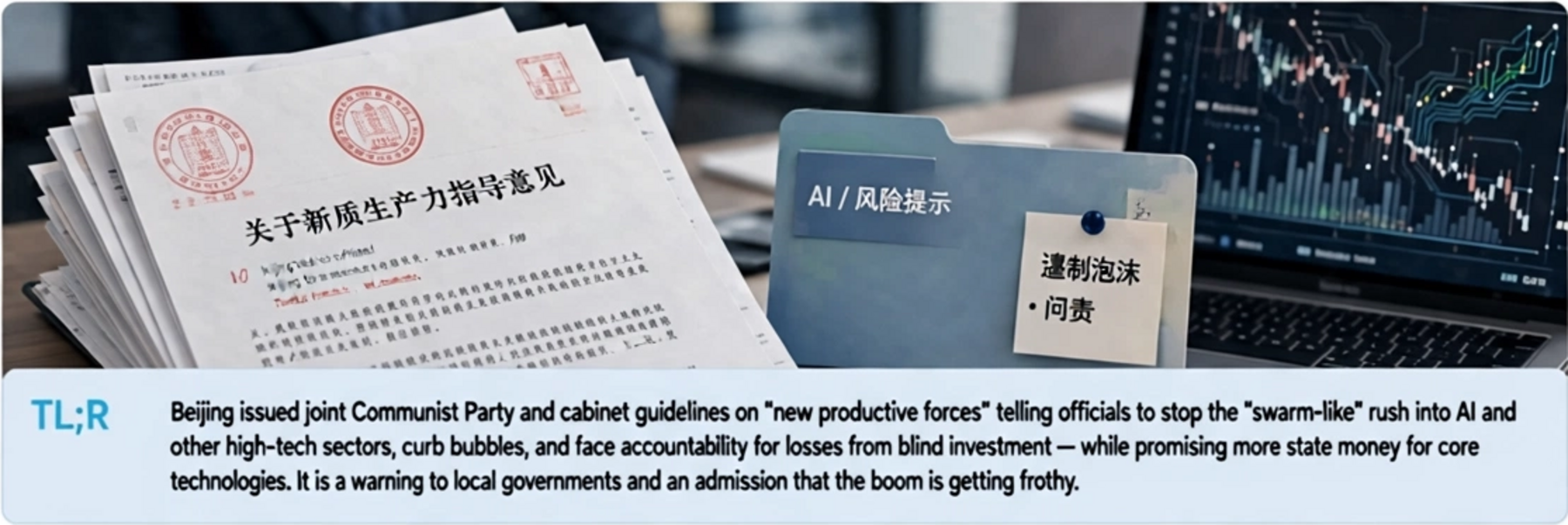
Two memos stapled together
The document is really two documents. One memo tells local officials to stop chasing the boom: no bubbles, no hollowing out industry, no "swarm-like" rushes into high-tech sectors, and accountability for anyone whose blind investment causes major losses. The other memo promises to speed things up: original and disruptive innovation in core technologies, the state-led "new nationwide system" to accelerate landmark products, national pilot bases for industrial AI. Beijing wants to floor the accelerator and the brake with the same foot. The honest reading is that it thinks it can tell the difference between a bubble and a breakthrough in advance. History suggests it cannot, which is why the brake paragraph is longer than the accelerator paragraph.
The target is local government, not startups
The sharpest line in the guidelines is aimed at the bureaucracy itself: "strictly prohibit the illegal or improper abuse of policies in the name of developing new productive forces." Translation: local governments have been slapping the "new productive forces" label on pet projects to unlock subsidies, land, and approvals. The accountability clause, officials held responsible for major losses from blind investment, is Beijing trying to make career risk do what market discipline cannot in a state-led system. For investors, this is the part to price: Chinese local governments have been among the biggest backers of AI video and model startups. If the money was chasing policy labels rather than returns, some of it is about to get more cautious.
What it means if you build on Chinese AI
The sanctioned lane is now explicit: industrial AI applications, pilot bases, AI Plus upgrades to traditional industries. That is where the state money and the approvals will keep flowing. The unsanctioned lane is the speculative consumer rush. We have already covered what that looks like at the far end: China's AI short-drama boom has a 98.7% casualty rate. Guidelines like this rarely kill a hype cycle outright. They do something quieter: they raise the cost of being wrong for the officials funding it. Expect consolidation among the hundreds of AI video apps, tighter scrutiny of new data center and chip-fab proposals framed as "AI infrastructure," and more pilot-base ribbon-cuttings. The practical read for anyone building on models from MiniMax, DeepSeek, Moonshot, or Zhipu: the model labs with real revenue survive a discipline cycle; the wrappers built on subsidy money do not.
Sources
- [1] Reuters via WIXX — “China vows to curb tech bubbles, keep AI risks in check” (Oct 9, 2026)Read source