
A first, at an unspecified scale
Chip IP businesses live on milestones that are real but hard to weigh. Ceva's November 2 announcement is one of those. Mobilint, a Seoul fabless company founded in 2019, has put two Ceva designs — the SensPro AI DSP and the NeuPro-Nano NPN32 NPU — into its REGULUS edge AI chip, and Ceva calls REGULUS the first production deployment of its NeuPro NPU family. For a company that licenses designs rather than selling chips, a licensee reaching production is an important commercial milestone: the design has moved beyond evaluation and into a product intended for the market. It may also create royalty revenue for Ceva, depending on the licensing agreement and the terms of the deployment. Neither company disclosed the royalty structure or expected revenue from REGULUS.
What the announcement cannot tell you is the size of that point. There is no production volume for REGULUS, no named customer for the chip or for the one product built on it, and no price for either. Ceva's boilerplate offers scale — more than 22 billion devices shipped, 400-plus customers — but those numbers cover everything Ceva has ever licensed, from Bluetooth to 5G. The NeuPro family's disclosed production footprint is one licensee's SoC, with a shipping commercial product built around it. That is a genuine first for the family. It is not yet evidence of broad deployment: neither Ceva nor Mobilint has disclosed production volumes, named customers or revenue attributable to REGULUS.
The chip itself
REGULUS is a standalone processor, not an accelerator that needs a host. Mobilint's product page describes a 17mm chip that runs Linux and the application itself, delivers 10 TOPS of dense INT8 compute, encodes video at 4K 60 FPS in hardware, and stays under a 3W power draw, with up to 8GB of memory. Ceva's two blocks divide the work: SensPro takes sensing and signal processing, NeuPro-Nano takes always-on neural inference, and Mobilint's own architecture sits alongside both.
The specification is aimed at edge devices rather than general-purpose AI infrastructure. Its selling proposition is the combination of local inference, image processing and hardware video encoding within a power budget below 3W, according to Mobilint and Ceva. The announced specifications do not establish how REGULUS compares with competing edge processors on real-world workloads. The release aims it at robotics, drones, machine vision, smart cameras and IoT devices — enclosures where the heat and battery budgets were fixed before the AI requirement arrived. Mobilint says more than 490 model architectures across CNN, RNN and transformer families have been validated for its platform. Its SDK qb compiles supported models for REGULUS, giving developers a broader starting point than the raw TOPS figure alone suggests. The company has not published independent adoption data showing how many customers are deploying those models in production.
What is actually shipping
The most concrete sentence in the release is about a USB stick. Mobilint's MLD-R1, an AI USB accelerator built on REGULUS and previewed at COMPUTEX 2026, is now shipping, aimed at adding on-device AI to existing systems in smart factories, security, medical devices and digital signage. A product described as shipping is a more concrete commercial milestone than a roadmap announcement. It gives prospective customers a product to evaluate, although Mobilint has not published a price, shipment volume or named customer for the MLD-R1.
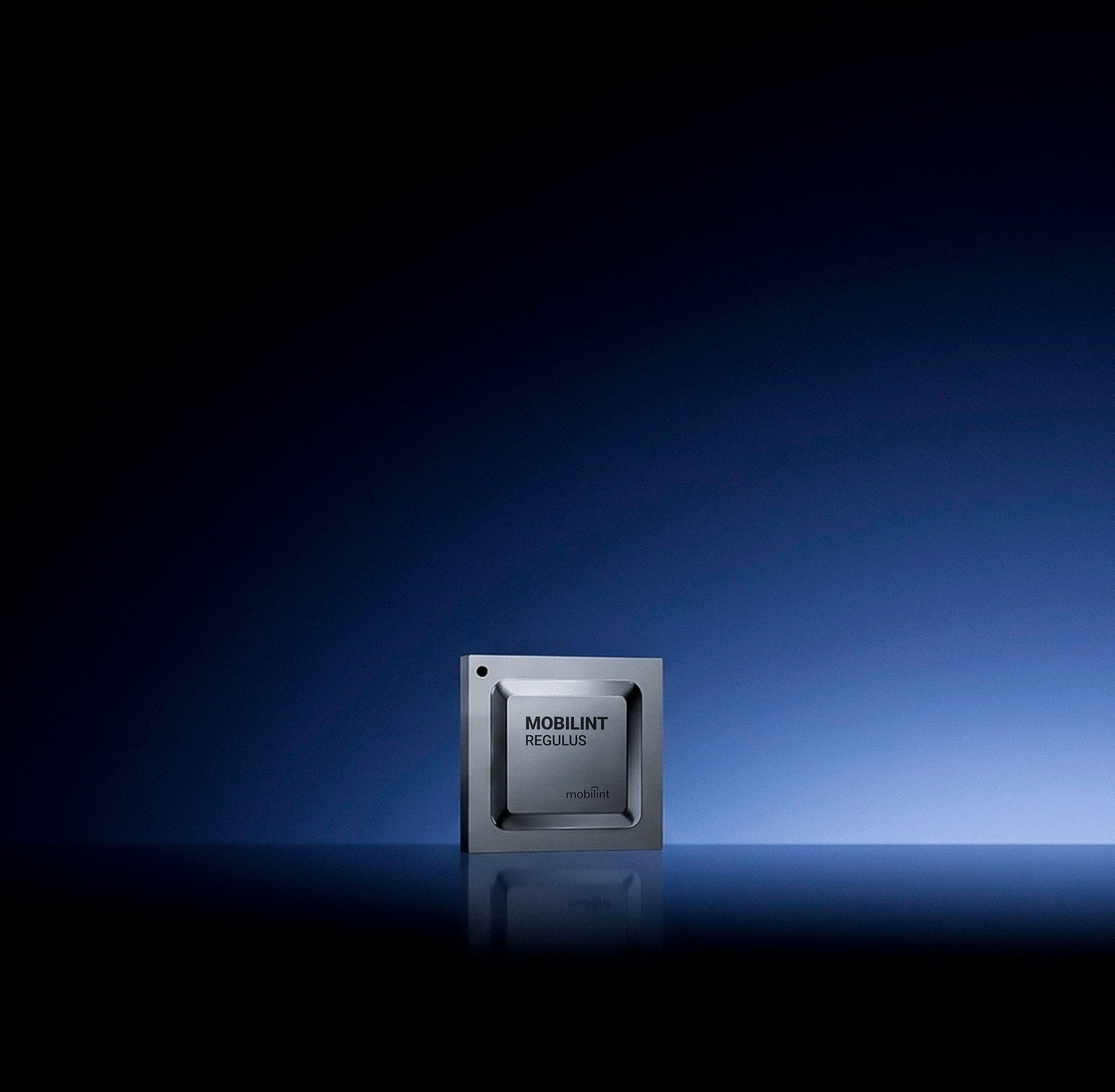
Even there, the public record stops early. Neither the release nor Mobilint's product page, checked on November 2, publishes an MLD-R1 price, a production run, or a customer. So the honest summary of the milestone is narrow: Ceva's newest NPU family has crossed from licensing into production silicon, inside a chip with sensible specs for its niche, with one shipping commercial product attached. Whether that becomes a royalty line worth modeling depends on numbers neither company chose to publish. Watch for the first named design win or a volume figure; until one appears, "first production deployment" is a starting line, not a result.
Sources
- [1] Ceva, Inc. — "Ceva and Mobilint Advance Physical AI with REGULUS Edge AI SoC," PR Newswire, November 2, 2026 (first production deployment claim, SensPro + NeuPro-Nano NPN32 integration, 10 TOPS at under 3W, up to 8GB memory, target applications, MLD-R1 now shipping and its framework support, quotes from Dongjoo Shin and Yaron Galitzky, Mobilint and Ceva company descriptions including the 22 billion devices / 400+ customers boilerplate; read first-hand)Read source
- [2] Mobilint — "REGULUS AI SoC — On-Device AI at 3W," official product page (10 TOPS dense INT8, 17mm chip, host-independent Linux operation, 4K 60 FPS hardware encoding, SDK qb, more than 490 validated model architectures, Yocto Linux SDK; no price published; checked November 2, 2026)Read source