
What a decision model is, in one paragraph
Most models generate text and leave the judgment to whatever reads it. A decision model takes a state — a document, a conversation, a policy — plus a set of fixed questions, and returns a calibrated probability for each answer: yes or no, which named option, which level on an ordered scale. Ticket triage, spam and jailbreak screening, routing a request to the right team. The output is a number a system can threshold, not a paragraph a human has to interpret. Bison-1 answers all of the questions in a single shared-prefix prefill and generates no text at all.
One point on the index
The launch claim is accurate and narrow at the same time. On the Artificial Analysis Decision Index v2.1, scored on November 19, 2026, bison-1's 76 puts it first among 19 decision models. Second place, d1.2-ultra, scored 75. Baseten's previous flagship, mammoth-1, scored 71 — five points lower on this index, while the gap to the nearest competitor is one.
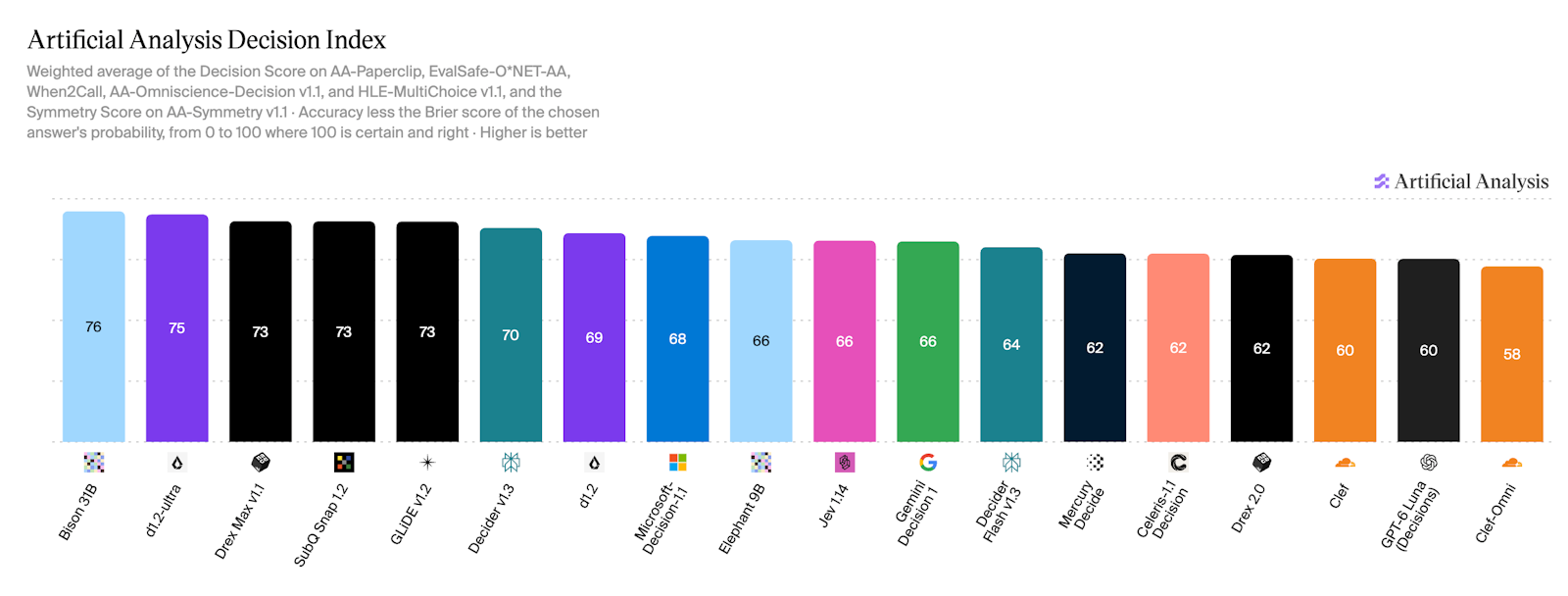
The Brier comparison follows the same pattern. Bison-1's Brier score of 0.14 is the lowest on the index; the runner-up sits at 0.15. A Brier score measures probabilistic prediction error — calibration together with how well predictions distinguish outcomes — so the lead is real and narrow at the same time.
The component scores explain why the aggregate should not be read as uniform strength. Bison-1 ranks first on When2Call (98), EvalSafe-O*NET-AA (93), HLE-MultiChoice v1.1 (51) and AA-Symmetry v1.1 (89), and second on AA-Paperclip (73). On AA-Omniscience-Decision v1.1 it scored 60 and ranked 11th of 19. Four firsts, a second and an 11th sit behind the same aggregate. Teams whose workload looks like the omniscience test, judging what a model does not know, are not buying the index winner in any meaningful sense.
The unscored sibling
Groundhog-1 is the model priced for volume: $0.035 per million tokens, a 26B mixture-of-experts build with about 4B active parameters. It shares the 128k context and the image input. What it does not have is an official Decision Index score in its launch materials. Baseten's launch post says the company expects groundhog-1 to match mammoth-1 on the official index. Mammoth-1 scored 71, five points below bison-1. An expectation in a launch post is not a measurement, and until Artificial Analysis scores the model, the cheaper tier of this release rests on the vendor's own estimate.
The change that is not a photo finish
The substantive upgrade in this release is not the ranking. The previous decision models on Baseten's API accepted 16k tokens of context. Bison-1 and groundhog-1 accept 128k, and they accept images alongside text. That changes what a decision call can contain: a full policy document instead of an excerpt, a long conversation history instead of a summary, a scanned invoice as an image instead of a transcription. Baseten's example is an invoice that looks payable until an earlier email in the thread shows the order was canceled. Context is where that fact lives.
Two supporting numbers need their labels kept on. The long-context results Baseten publishes for bison-1, 84.8 on LongMemEval M and 87.1 on LongMemEval S at 128k tokens, come from Baseten's own run, not from Artificial Analysis. And the training recipe is worth a line because it explains the calibration emphasis: 6.71 million decision examples, roughly one in seven carrying a probability target instead of a single correct answer, a Brier term in the objective, and a trained "I don't know" option.
The backbone argument
Baseten frames the release as a move to an American backbone. Mammoth-1 and elephant-1 were built on Qwen. Bison-1 and groundhog-1 are built on Google's Gemma 4, and the post presents that as a deliberate investment in models American teams can own and adapt. Readers can price that argument themselves. The verifiable part, from the bison-1 card, is the license stack: Gemma 4 carries Apache License 2.0 terms, Baseten's modifications are released under the MIT License, and use of the weights is subject to both. The weights are open on Hugging Face under the baselabs account, and both models use the same API as the earlier decision models, so switching is a model-name change.
Sources
- [1] Baseten, "Meet bison-1 and groundhog-1, frontier American decision models", November 20, 2026Read source
- [2] Base Labs / Baseten, bison-1 model card, Hugging FaceRead source
- [3] Artificial Analysis Decision Index v2.1 (as reported on the bison-1 model card, scored November 19, 2026)