
A monitor that is already in the room
Anthropic's strongest automated comparator is a standalone prompted classifier. It reads the conversation and the full safety policy again, then reasons through the case. That makes it more expensive to run across every conversation. Self-assessment takes a shorter route: the conversation is already in the model's cache when Claude finishes replying, so a brief instruction and about 10 additional output tokens produce a structured assessment.
That economy is the real announcement. At under 2% added compute, Anthropic can afford to run a judgment on a large fraction of all Claude traffic, where its first Constitutional Classifiers cost 23.7%. A cheaper monitor that runs across a large fraction of traffic can find things a more expensive monitor, deployed only selectively, may miss. Anthropic says more than half of the organizations it surfaced had produced no flags from other detection sources in the preceding month.
It is also, by design, a delayed instrument. Nothing is blocked in the moment. Flags are grouped by organization overnight, and only repeated high-priority flags reach a human enforcement team. Self-assessment itself does not block the response. If the other real-time safeguards do not stop it, the answer can reach the user. What changes is how quickly the pattern behind potentially harmful activity becomes visible to Anthropic's monitoring and enforcement teams.
There is also a data-handling qualification. Anthropic says self-assessment reads the conversation Claude has already processed and follows the same retention policies as its other automated systems; it does not collect additional user data. The system currently does not run on traffic covered by zero-data-retention agreements. Anthropic also acknowledges that investigating a flagged potential violation may require retaining the underlying conversation.
The score is agreement, not accuracy
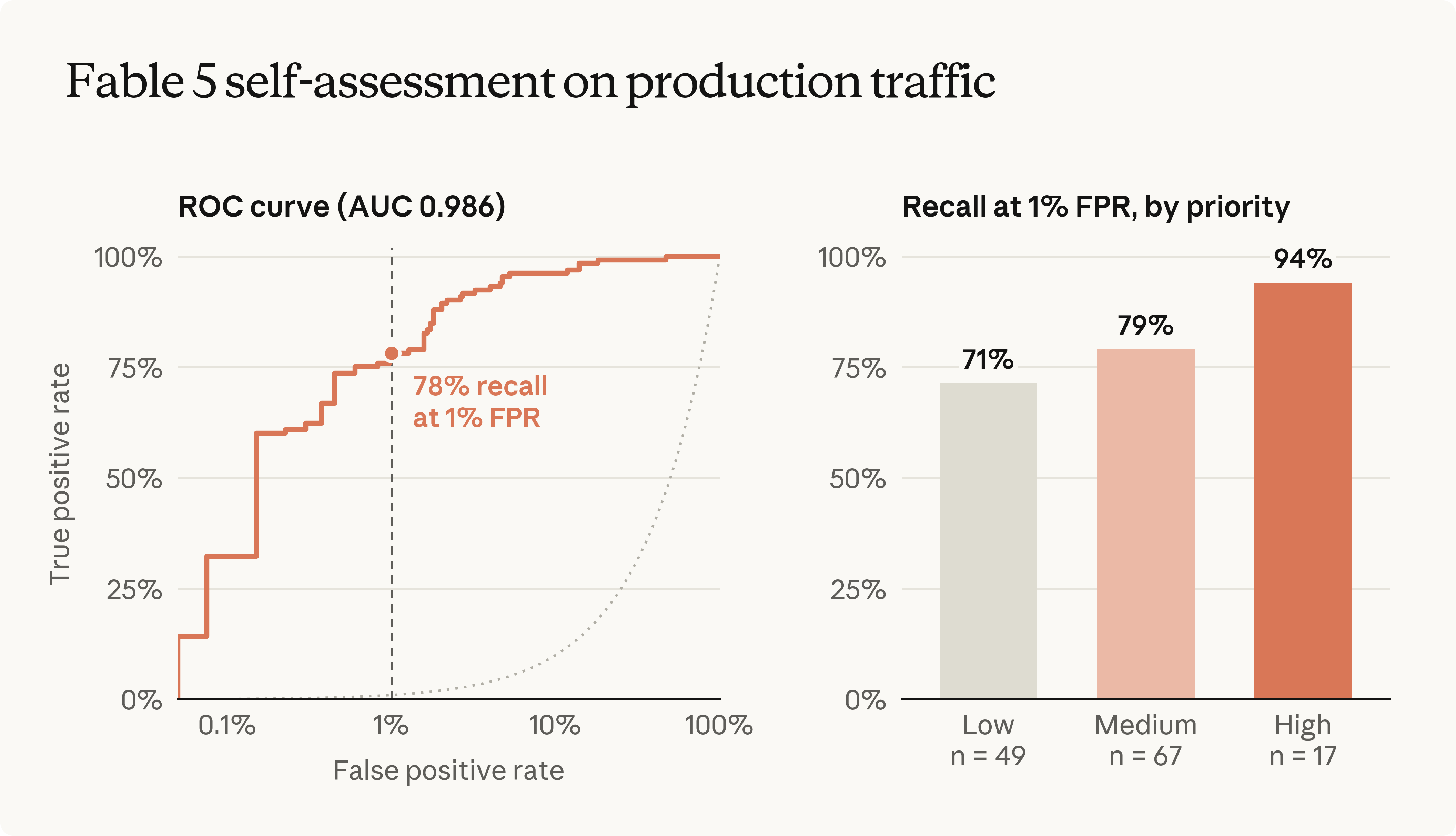
The 78% and 94% figures need their denominator. Both measure how often the built-in assessment agrees with a prompted classifier running on Claude Mythos Preview with the full internal policy in context. That classifier is also the teacher: it labeled the synthetic training data, its labels were distilled into the deployed models through fine-tuning and reinforcement learning, and it then graded the result. The reported 1% false-positive rate uses the same teacher-labeled evaluation framework. It should not be read as evidence that only 1% of genuinely harmless conversations are incorrectly flagged in real-world use.
Anthropic states the consequence plainly. Self-assessment inherits any weakness in its teacher, it is evaluated against the same teacher, and a blind spot shared by both cannot appear in the evaluation at all. Human evaluation is named as future work, not as part of this result. Read 94% as agreement with the teacher on conversations that the teacher classifies as high priority, which is a useful engineering result. It is not a measurement of how much real misuse Claude catches, because no independent label set has been published against which to check it.
The sample sizes add a second caution. The priority breakdown in Anthropic's own chart is 17 high-priority conversations, 67 medium and 49 low. With 17 high-priority examples, one additional miss would move the observed recall by roughly six percentage points. The result is encouraging, but the sample is too small to support a precise estimate of high-priority detection performance. Anthropic's separate model-scaling experiment does not resolve this limitation: it used different models and a separate evaluation set.
What it found, and where it is weak
The strongest evidence for the system is not the recall chart. It is the range of activity Anthropic says its monitoring surfaced: more than 100,000 child sexual abuse and exploitation flags associated with one API customer in August, a Claude Code romance-scam operation, and a substantial category of flags that did not fit its existing harm taxonomy. Anthropic says its child-safety team investigated the August activity and reported the material to the National Center for Missing & Exploited Children. In the romance-scam case, human review preceded the decision to ban the accounts involved. The out-of-taxonomy flags included suspected illicit distillation, prompt injection and agent actions that users had not authorized.
These are examples of how a broad monitor can help identify activity outside predefined detection categories. They are Anthropic's reported production findings, not an independently audited measurement of the system's detection accuracy.
The production system is passive: it flags conversations for review but does not block them. Anthropic separately tested whether it could be repurposed as a real-time blocking classifier. This was an offline red-team experiment, not a measurement of the production monitoring system.
The weakness is equally concrete. Asked to act as a blocker in a 24-task cyber test, self-assessment cut attack success only from 79% to 54%, while the expensive prompted classifier reached 25%. Anthropic's own framing is that the system works offline precisely because an attacker gets no signal from it, and that an attacker who targets the assessment directly could likely extract whether a request would be flagged and search for a way around it. There is a further limit the write-up names for monitoring Claude's own conduct: a model that produced an action is poorly placed to judge it, and a deceptive one could hide the action in the assessment too.
None of that makes the system a failure. It makes it a triage layer with a published cost, a published blind spot, and a production record that can be checked against future disclosures. That is a better basis for judging a safety claim than a single percentage, and it is the standard the next lab making one should be held to.
Sources
- [1] Anthropic safeguards research, "Scaling Misuse Detection with Self-Assessment", October 16, 2026 (primary — read first-hand: the 78% / 94% / 1% figures measured against the Mythos Preview teacher classifier, Figure 1's sample counts of 17 high-priority, 67 medium and 49 low conversations, the three-configuration blocking experiment run with production classifiers turned off, the August 100,000+ flags and the report to the National Center for Missing & Exploited Children, the September romance-scam ban after human review, the data-handling qualifications including the zero-data-retention exclusion, and the limitations section)Read source
- [2] PANews, "Anthropic: Claude Trained to Self-Assess Potential Abuse in Conversations", Oct 29, 2026, 18:27 UTC (records Anthropic's Oct 29 promotion of the research on X)Read source
- [3] RuntimeWire, "Anthropic uses Claude to flag misuse its safeguards may miss", Oct 29, 2026Read source
- [4] TechTimes, "Anthropic Says Claude Flagged More Than 100,000 Potential Child Exploitation Cases for a Single Customer", Oct 30, 2026Read source
- [5] Asad Ali, "Grading a model self-check: the blind spot Anthropic's self-assessment write-up names", Medium, Oct 2026 (independent critique of the teacher-graded evaluation, consistent with the primary source's limitations section)Read source