The cut that does not look like a cut
The number most likely to travel from this study is two. Out of 58 companies, two had seen AI automation fully eliminate a position and lead to someone losing their job. Set against a year of warnings about mass white-collar displacement, two sounds small.
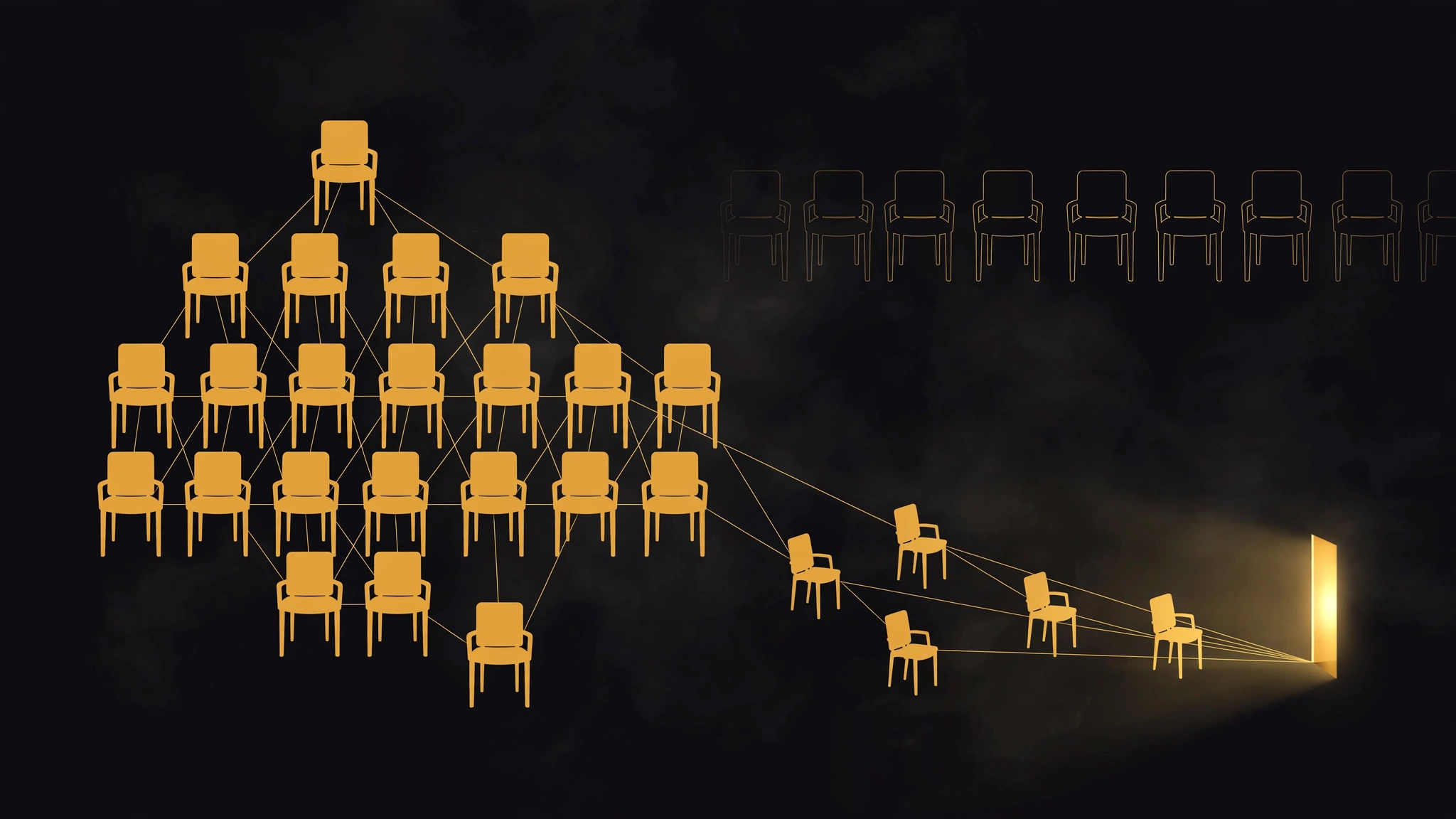
The same interviews contain the reason not to stop there. Two-thirds of the companies said AI had reduced their hiring. One person quoted in the study puts the mechanism plainly: "We may not be firing, but we're not hiring." A third of those hiring declines came from letting functions shrink through attrition without backfilling the roles. Most of the rest were positions the company would have created to grow, and now will not. An engineering leader at a health management company describes the trade directly: "We've added a lot of capacity by buying tokens instead of hiring people."
A job that is never posted does not appear in a layoff count. Neither does a contract that is not renewed. Nine companies described cutting contracted software developers, customer service representatives, legal counsel and back-office functions, many of them previously offshored. One finance company downsized well over 100 offshore data and developer contractors. Anthropic itself flags this as the early-warning part of its own findings, pointing at the international business services industry rather than at domestic headcount.
There is also a smaller, harder category. Five companies described pushing out employees who would not adopt AI. That is not automation eliminating a role. It is an employer deciding that refusal to use the tool is itself a performance problem.
What the firms say the value is
The study is more useful on value than on jobs, because it separates output from cost. Interviewees described most of the nearly 300 applications discussed as adding value by increasing output, not by cutting costs. About half of the applications that increased output did so by accelerating or expanding existing work. The other half improved the quality of products and services or created new ones: a medical group giving patients an upfront estimate of after-insurance costs, a dental company answering calls after hours instead of sending them to voicemail.
The software figures point the same way. Of 100 AI-written projects described in enough detail to categorize, 80% automated work that had been done manually, and 20% replaced existing software, often software the firm had been buying from outside vendors. That is a change to what a firm buys, not to how many people it employs.
The pattern Anthropic draws from this is organizational. Light-touch uses, such as ad hoc analysis or slide design, fit into an existing structure and were often rated low value by the people describing them. The higher-value deployments required changing a process or a role: broadening a job so one person owns a whole workflow, or moving people toward the tasks that become bottlenecks once coding speeds up, starting with code review. As one accountant quoted in the study puts it, the gain is "a combination of process re-engineering and systematic discipline."
That finding should be read with the caveat the authors attach to it. The value ratings are, in their words, primarily qualitative descriptions from interviewees, not typically based on A/B tests or other quantitative assessment.
Who was asked
Every company in the sample is an Anthropic enterprise customer. The authors are explicit that the firms were selected for their range across industry, size and AI usage, and that they are not a random or systematically representative sample. Interviews were anonymous, and any names in the report are pseudonyms.
That does not make the study useless. It makes it a specific kind of evidence: what a vendor's own customers, chosen for range, report after adoption is already under way. It should not be read as a labor-market estimate, and the authors do not present it as one.
Read on those terms, the study still says something the layoff debate usually misses. Inside these 58 firms, the effect showing up in their own accounts is not a wave of terminations. It is a quieter change in how many people they plan to add, which contractors they keep, and which roles they expect one person to cover. It does not produce a layoff headline. It is also where a reader deciding whether to hire, apply or retrain should be looking.
Sources
- [1] Anthropic, "Working with AI" (Nathan Wilmers, Maxim Massenkoff and Peter McCrory), November 23, 2026Read source
- [2] AI Weekly, "Anthropic Study of 58 Firms Finds Few Layoffs, Slower Hiring" (secondary roundup, used only to cross-check the counts)Read source