A rack that leaves the model out
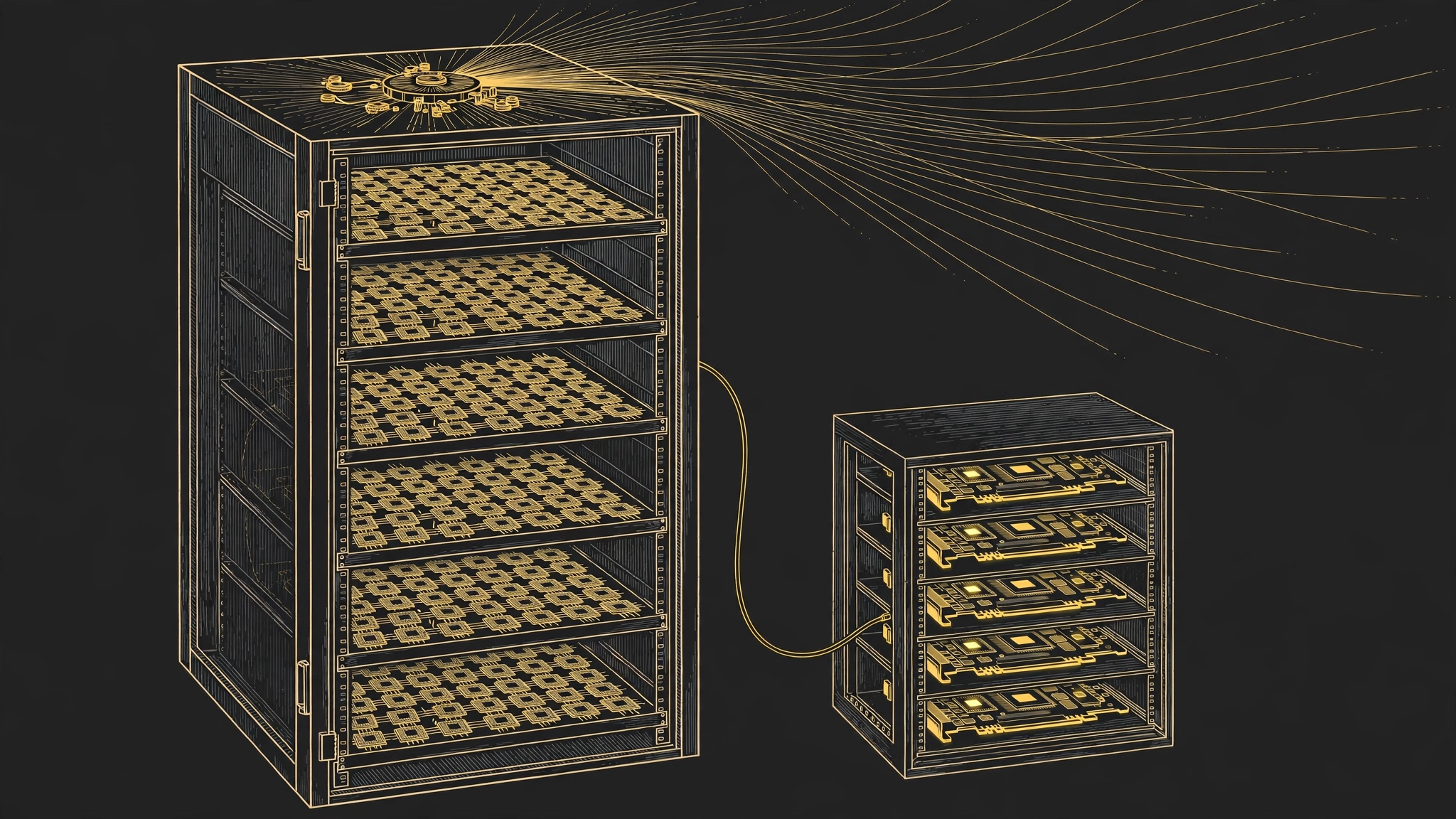
Most AI rack announcements are about feeding a model faster. Helion starts from the other end. An agent spends much of its time not generating tokens but doing ordinary computing around the generation: executing code, calling tools, checking results, deciding which model to ask next. AMD's argument is that this work has different hardware needs from inference, so it should get its own rack — in the extreme configuration, a CPU-only rack that connects outward to separate inference systems.
That is the idea worth taking seriously here. If agent workloads really do spend a large share of their cycles on orchestration, then GPU-dense racks are an expensive way to run them, and a dense CPU rack with a router on top starts to look like sensible engineering rather than a product line in search of a problem.
Reading the headline number
The 32,768-core figure needs its qualifier. It is the ceiling of one example configuration, not a standard build, and AMD's own release presents it as what the blueprint "can support." Core counts at rack scale also say little on their own: they depend on how many nodes a partner packs in, and AMD published no performance, power or cost figures to set against the number. Treat it as a statement about density being possible, not evidence about what a shipping Helion rack will look like.
The same caution applies to the launch itself. Helion was introduced as a spec-design that AMD plans to contribute to the Open Compute Project. The partner statement section is long — Cisco, Dell, Foxconn's parent, HPE, Lenovo, QCT, Supermicro and Wiwynn all appear — but partner endorsements of a blueprint are not orders, and the release gives no customer deployments. AMD says partner configurations are under development and planned to become available in November 2026. It has not identified a firm shipping date, confirmed customer orders or a deployment schedule.
The router is the tell
The most revealing component is the smallest one in the announcement: an integrated token router that sends an agent's model calls across frontier and open-source models. That feature concedes something the model makers prefer to blur. In an agent stack, the model is a replaceable part behind a routing decision. AMD's integrated token router makes model selection part of the infrastructure design, potentially allowing agents to direct requests across multiple model providers. That could give infrastructure operators more control over inference routing, but AMD has not established that Helion's router must handle every call or that the company controls the routing layer in customer deployments.
Read that way, Helion is less a challenge to Nvidia's inference business than a bid to own the layer above it. AMD is not claiming its GPUs win the model. It is claiming the surrounding work — execution, routing, general compute — is large enough to deserve open, CPU-led infrastructure, and that hyperscalers would rather build that layer on an open specification than inside a rival's closed rack.
What to watch
Three things will decide whether this matters. First, whether partner configurations actually arrive in November 2026 close to the configurations AMD described. Second, whether any hyperscaler deploys the CPU-only variant at scale, which is the version that tests the split-execution thesis. Third, pricing: AMD announced none, and a blueprint's economics only become real when a partner puts a number on a built rack. Until then, Helion is a well-argued position paper with a core count attached.
Sources
- [1] AMD newsroom, "Introducing AMD Helion, Agentic AI Compute at Rack Scale," October 12, 2026Read source
- [2] AMD Helion product page (supporting technical reference) — amd.com
- [3] The same AMD release via GlobeNewswireRead source
- [4] Data Center Dynamics, "AMD unveils Helion rack to support agentic AI workloads," October 12, 2026Read source