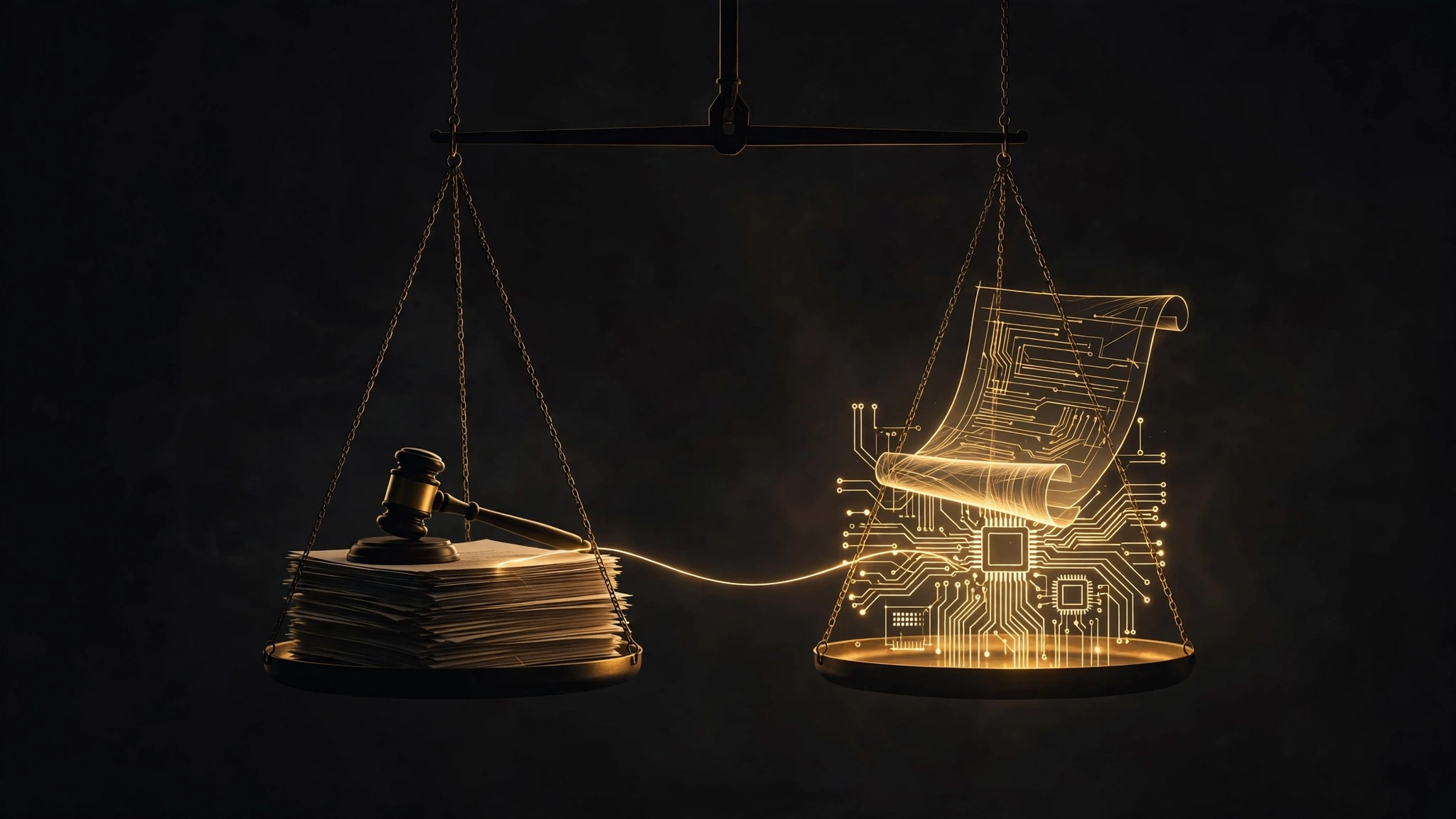
The American Arbitration Association first introduced its AI Arbitrator at the narrow end of its caseload: two parties, documents only, construction disputes, no live witnesses. On November 9 it widened the gate. The AI Arbitrator is now available for business-to-business disputes across industries, on the same two conditions. Two parties. Documents only.
Under the published rules, parties submit position statements, evidence and legal authorities. The system organizes the record, summarizes each side's claims, and lets each party check the summary of its own case before the analysis proceeds. It then applies the law to the record and drafts a proposed award with citations. A human arbitrator trained in reviewing the tool reads the draft, revises it where needed, and issues the final award. The AAA says the system behind the commercial version was trained on cases from more than 20 industries.
That is the announcement. The terms that decide whether a business should use it are somewhere else, in the AAA's AI Led Arbitration Rules, and they repay reading.
The price and the clock are in the rulebook
The announcement gives no fee and no deadline. The rules give both. Filing a claim costs the claimant $2,500, flat. A counterclaim costs the respondent another $2,500. The fee covers the AAA's administrative costs and the human arbitrator's compensation, and it is not refunded, with one exception: if the respondent refuses to arbitrate under the AI-led rules, the claimant gets the money back.
The timetable is fixed at each stage rather than end to end. The respondent first has 10 business days to agree and respond. The claimant's submission, the respondent's submission and the claimant's reply then each get 10 business days, with a further reply round where a counterclaim requires one. Each party may request one five-business-day extension for each submission period. The rules provide sequential submission periods, including an additional reply where a counterclaim requires one. The award deadline is five business days after the feedback-stage deadline — not five days after filing.
Two more points in the rules matter more than the headline suggests. First, the rules reviewed state no dollar cap. That absence does not guarantee acceptance of every claim amount. A claimant states the amount sought, and eligibility is decided by the shape of the case. Second, consent is written into the rules in plain language. By choosing this process, both parties consent to have the AI Arbitrator make a preliminary decision in the case, with the human arbitrator reviewing, revising as needed, validating, and finalizing that decision and issuing the award. Anyone signing up should read that sentence as the actual product description.
What the parties cannot check
The AAA presents the human arbitrator as the safeguard, and the safeguard is real as far as it goes. The human can approve the draft, edit it, or rewrite any part of it, and no award is final until that person signs it. Arbitrators on these cases receive specialized training in reviewing AI analysis, and they must disclose anything that could raise doubts about their impartiality, before and during the case.
The gap is on the parties' side of the process. A party can verify that the AI understood its submission, because it sees and can correct the AI's summary. It cannot see the draft award the AI then produced from that record. It sees only the final, signed award. Parties cannot compare the AI draft with the final award to assess the human's changes. The AAA's own FAQ states this directly, in answer to whether parties can review the draft: they cannot.
The savings figures need the same care. The FAQ reports 20 to 25 percent faster resolution and cost savings of at least 35 percent. Those numbers come from early testing in documents-only construction disputes, the pilot caseload, and the FAQ page still describes the service in its original construction-only terms. AAA supplies no corresponding results for the broader service that opened this week.
California's delegation rule raises an unresolved question
The expansion arrives less than two months before a California law on AI delegation in arbitration takes effect. Senate Bill 574, signed on September 30, 2026 and effective January 1, 2027, adds a section to the California Arbitration Act stating that an arbitrator shall not delegate any part of their decision-making process to any generative AI tool. On Mayer Brown's analysis, it also bars an arbitrator from relying on AI-generated information from outside the record without disclosing it to the parties and, where practical, giving them an opportunity to comment.
Whether the AAA's structure breaks that rule is, for now, a genuinely open question. Writing before the expansion, in an October 26 analysis of the statute, Mayer Brown's lawyers described the AI Arbitrator as the first service from a major arbitral institution to generate awards rather than merely assist, and asked whether its safeguards — party consent, a narrow case type, mandatory human review — will satisfy legislatures and courts that now insist the decision remain a human one. The expansion widens the case type, which was one of those safeguards. The sources reviewed identify no ruling on whether this AAA structure satisfies SB 574, and the law does not apply everywhere. But a business choosing this process for a California-seated dispute in 2027 is choosing it under a statute whose application to this kind of human-reviewed structure is untested.
None of this makes the service a bad buy. For a straightforward dispute that lives entirely in documents, a flat $2,500 and an award deadline measured from a fixed process is a serious offer. It is an offer with specific terms, though, and the terms are the story: consent to a preliminary decision by software, a draft neither party will ever read, savings figures carried over from a pilot, and a state law about to ask whether the human review at the end is enough.
Sources
- [1] American Arbitration Association, "The AI Arbitrator from the American Arbitration Association, Now Available for Commercial Cases", PR Newswire, November 9, 2026, 13:30 UTC (expansion to all two-party, documents-only business-to-business cases; training on cases from more than 20 industries; human-review structure; Diana Didia and Sasha Carbone statements)Read source
- [2] American Arbitration Association, AI Led Arbitration Rules, amended and effective February 18, 2026, read in full November 10, 2026 (R-2 consent to a preliminary AI decision; R-6 submission schedule and extensions; R-8 draft award, human power to approve, edit or rewrite, and five-business-day award deadline; R-10 removal of cases with more than two parties; R-13 optional non-binding award; cost schedule of $2,500 per claim and $2,500 per counterclaim, refund only when the respondent does not consent)Read source
- [3] American Arbitration Association, "How AAA's AI Arbitrator Keeps Humans Involved" (AI Arbitrator FAQ) (parties do not see the AI draft award; both parties must agree; early testing showed 20–25% faster resolution and 35% or greater cost savings in documents-only construction disputes)Read source
- [4] Mayer Brown, "California Becomes First US State to Legislate Limits on AI Use by Arbitrators and Counsel", October 26, 2026 (SB 574 signed September 30, 2026, effective January 1, 2027; new Section 1282.1 bars delegation of any part of decision-making to a generative AI tool; whether the AAA AI Arbitrator's safeguards satisfy legislatures and courts is an open question)Read source
- [5] TechTimes, "American Arbitration Association Opens AI Arbitrator to Business Disputes at $2,500 Per Claim", November 10, 2026 (the report that first set the announcement against the published rules and SB 574 in one place; used as a cross-check, with every load-bearing figure verified against the AAA rules above)Read source